


Why Your LinkedIn Content Workflow Is Costing You More Than You Think
Why fragmented tools, not writing itself, are the real reason so many LinkedIn content plans quietly stall.
13 min read
Share this post
Summarize with AI

Most LinkedIn creators think publishing is slow because writing is hard. The real cost is the fragmented workflow around it, ideas in one app, drafts in another, approvals in chat. Here is why that friction quietly kills consistency, and what a connected workflow looks like instead.
Why Your LinkedIn Content Workflow Is Costing You More Than You Think
Introduction
Most LinkedIn creators assume content creation is slow because writing is difficult. In reality, the largest source of wasted time is the workflow surrounding the writing itself. Ideas are captured in one app, drafts live in another, graphics are produced elsewhere, approvals happen in chat, and scheduling takes place in a completely different platform. Every transition interrupts focus and makes publishing feel harder than it should.
A fragmented process also increases inconsistency. When drafts, comments and visuals are scattered across multiple applications, simple revisions take longer and publishing deadlines slip. Teams frequently duplicate work because nobody has a complete view of the process.
This is not a small operational inconvenience. It is the reason so many promising LinkedIn strategies quietly stall after a few weeks. A founder gets excited about a content plan, publishes consistently for a month, and then the calendar goes quiet the moment a product launch or hiring sprint demands their attention. The strategy did not fail because the ideas were bad. It failed because the system supporting those ideas was too fragile to survive real business pressure.
Understanding exactly where that fragility comes from is the first step toward fixing it, and that starts with looking closely at what happens inside a creator's brain every time they switch tools.
The Hidden Cost of Context Switching
Cognitive research consistently shows that switching between unrelated tasks reduces productivity. For LinkedIn creators this means moving between research, drafting, editing, design, analytics and scheduling. Although each switch lasts only a few seconds, the mental effort required to regain focus adds up throughout the day. Instead of spending energy developing stronger ideas, creators spend it remembering where files, drafts and assets are stored.
Beyond lost time, frequent switching reduces creative quality. Storytelling depends on maintaining a continuous train of thought. Interruptions break that flow, making posts feel generic or incomplete. This explains why many creators begin with enthusiasm but struggle to maintain a weekly publishing rhythm.
Think about what a single post actually requires under a fragmented setup. An idea gets jotted down in a notes app during a commute. Later, that note gets copied into a document for drafting. The draft gets pasted into a design tool to build a carousel or graphic. The graphic gets exported and uploaded into a scheduler. Somewhere in between, a colleague is asked for feedback over chat, and their comments have to be manually applied back into the original draft. By the time the post goes live, it has passed through four or five separate applications, each with its own login, its own interface, and its own way of losing track of version history.
Every one of those handoffs is a place where quality can quietly degrade. A strong hook gets diluted because the writer forgot the original angle by the time they reached the design stage. A typo survives because nobody was looking at the final version in the same place they approved the draft. None of this is a failure of skill. It is simply what happens when a creative process is stretched across too many disconnected surfaces.
There is also a compounding effect worth naming directly. The first switch of the day costs a little focus. The tenth switch costs much more, because the creator is now tired, distracted, and increasingly tempted to cut corners just to get the post published. This is why so much LinkedIn content published late in a busy week reads noticeably weaker than content published on a calmer Monday morning. The idea quality did not necessarily change. The available mental bandwidth did.
The Anatomy of a Fragmented Workflow
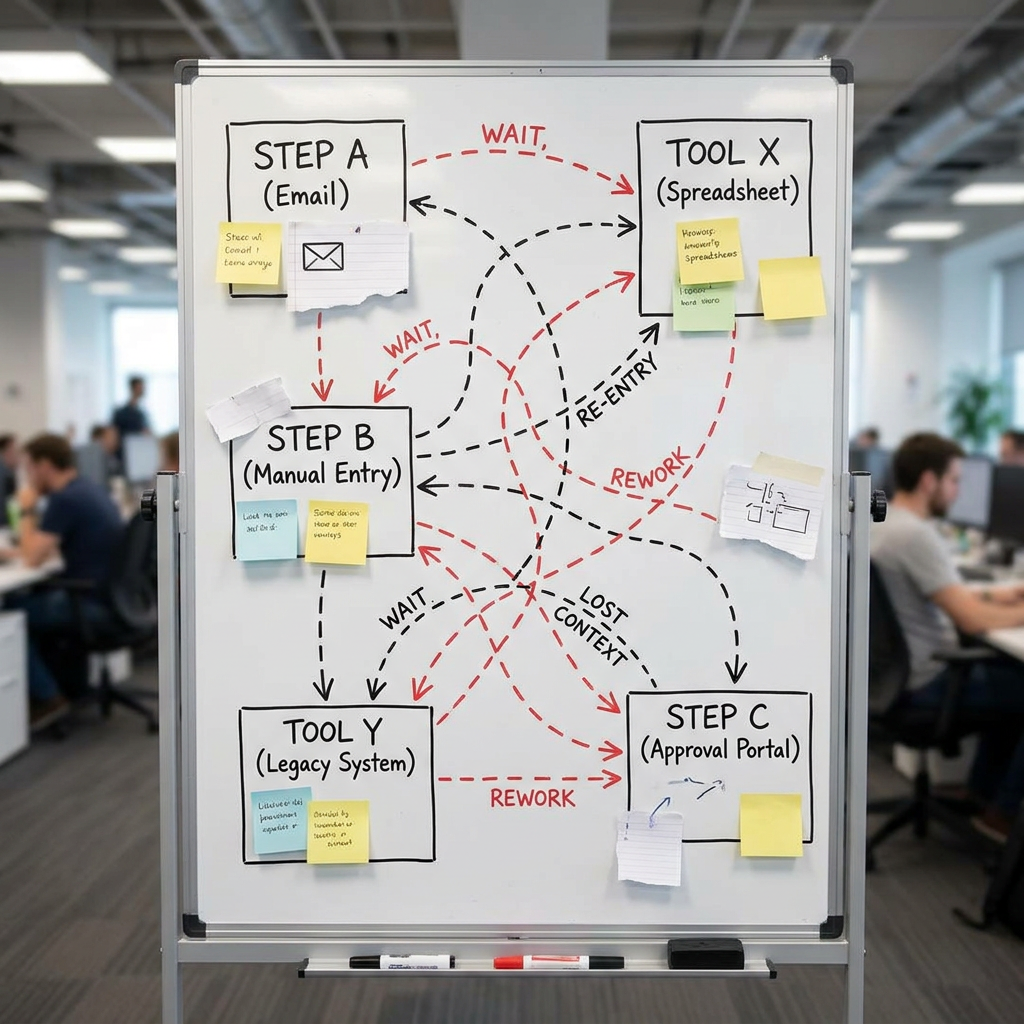
It helps to break the LinkedIn publishing process into its individual stages, because each one tends to live in a different tool for most creators and teams.
Idea capture usually happens wherever inspiration strikes: a notes app, a voice memo, a screenshot of a competitor's post, or a message sent to yourself on a messaging app. These ideas rarely make it into a structured backlog, which means many of them are simply forgotten.
Drafting typically moves to a document editor or directly into a chat interface with an AI writing tool. This is often the most creative stage, but it is also where context is most easily lost if the original idea capture was scattered.
Visual creation, for creators who use carousels or graphics, happens in a separate design tool. This requires exporting text from the draft, reformatting it to fit slide constraints, and manually applying brand colors, fonts and layouts each time.
Approvals, for teams and agencies managing multiple stakeholders, happen over chat threads, email, or shared documents with comments. Feedback frequently arrives out of order, gets lost in long threads, or contradicts earlier feedback because nobody has a single source of truth.
Scheduling and publishing move to yet another tool entirely, one built primarily around a calendar interface rather than around the quality of what is being published.
Analytics, finally, live either inside LinkedIn itself or inside a separate reporting dashboard, disconnected from the drafting and planning stages that came before it. This means lessons from past performance rarely make their way back into future content decisions.
Laid out this way, it becomes obvious why publishing consistently feels exhausting even for people who genuinely enjoy writing. The problem was never the writing. It was the six or seven handoffs surrounding it.
What a Modern Workflow Looks Like
An effective LinkedIn workflow begins with idea discovery, continues into drafting, editing, visual creation, approvals, scheduling and performance tracking without forcing users to constantly change software. Centralising these stages reduces friction and creates a repeatable publishing process.
The workflow should also preserve brand voice. Templates, saved styles, reusable assets and AI guidance ensure every post reflects the same positioning without requiring creators to start from zero.
A modern workflow treats each of these stages as connected rather than isolated. When an idea is captured, it should be immediately available for drafting without a copy-paste step. When a draft is approved, the visual creation stage should already understand the brand's colors, fonts and layout preferences rather than requiring the creator to rebuild them from scratch every time. When a post is scheduled, the performance data from previous, similar posts should be visible right there, informing the decision rather than living in a separate spreadsheet that nobody opens until the end of the quarter.
This kind of connected system also changes how teams collaborate. Instead of a marketing lead exporting a draft to send to a founder for approval, both people can view and comment on the same version in the same place. Instead of an agency owner tracking five client accounts across five different sets of tools, each account operates inside the same structure, which makes onboarding new team members dramatically faster and reduces the risk of losing institutional knowledge when someone leaves.
None of this requires creators to give up creative control. If anything, a connected workflow gives creators more room to focus on judgment calls, like which angle to take on a story or how to frame a controversial opinion, because the mechanical parts of publishing are no longer competing for their attention.
Business Impact
Founders and marketers who remove operational friction publish more consistently because the effort required for every post decreases. Consistency improves audience familiarity, increases opportunities for engagement and creates a larger library of searchable content over time.
Over a year, recovering even thirty minutes per post translates into dozens of additional working hours. Those hours can be redirected toward customer conversations, product development or deeper research instead of administrative work.
The business impact goes beyond simple time savings, though. LinkedIn's algorithm rewards accounts that publish predictably, because predictable publishing gives the platform more signals about how an audience responds to a creator over time. An account that posts three times one week and then disappears for two weeks sends a much weaker signal than an account that posts twice a week, every week, for six months straight. Consistency compounds in a way that occasional bursts of high-quality content simply cannot replicate.
There is also a trust dimension that matters especially for founders and consultants building a personal brand. Audiences learn to expect content from accounts that show up reliably. That expectation becomes a habit, and habits are what convert casual scrollers into engaged followers who eventually become customers, referral partners, or hires. A founder who disappears for a month after a strong launch post loses some of that accumulated trust, even if the underlying business is doing well. The market does not see the business. It sees the feed.
Finally, a smoother workflow changes who gets to participate in content creation inside a company. When publishing requires deep tool expertise, only one or two people on a team can realistically manage it, which creates a bottleneck. When the workflow is simple enough for a marketing coordinator, a founder, and a freelance consultant to all use the same system without extensive training, content production scales without requiring the company to hire a dedicated specialist for every function along the way.
How Different Teams Experience This Problem
The friction described above does not look identical for every kind of team, and it is worth being specific about who feels it most.
Marketing leads at growing companies are usually juggling company updates, thought leadership and case studies at the same time, while also being asked to prove return on investment to leadership. For this group, the workflow problem shows up as an attribution problem. Without a connected view of what was published, when, and how it performed, it becomes nearly impossible to show a clear line between content effort and pipeline results.
Agency owners face a different version of the same issue, multiplied across clients. Managing five, ten, or twenty client accounts through disconnected tools means approvals, reporting, and brand consistency all have to be rebuilt manually for every single client. This is often the single biggest constraint on an agency's ability to grow without proportionally growing headcount.
Startup founders experience the problem as a time tax on an already overloaded schedule. Founders rarely have a dedicated content team, which means every extra step in the publishing process is a direct subtraction from time spent on the product or on customers. For this group, workflow friction is not an efficiency issue. It is a reason content gets abandoned entirely during busy quarters.
Independent LinkedIn creators and freelance consultants feel the fragmentation most acutely because they are doing every job themselves: strategist, writer, designer, and analyst. A disconnected toolkit does not just slow them down, it actively contributes to burnout, since every publishing cycle requires holding the entire mental model of the process in their own head.
Recognizing these differences matters because it shows that workflow friction is not a niche complaint from a small group of power users. It is a shared cost across nearly every kind of person actively trying to grow on LinkedIn.
Choosing a Workflow Tool
Instead of comparing tools solely on scheduling features, evaluate how well they integrate ideation, collaboration, AI assistance, asset management, approvals, analytics and publishing. The best workflow tools eliminate unnecessary decisions rather than simply adding more features.
Questions worth asking include: Can ideas become drafts in one click? Can designers and writers collaborate without exporting files? Can performance insights feed directly into future content planning?
It is also worth asking how a tool handles the messy, non-linear reality of real content work. Ideas rarely arrive in a neat, chronological order. A founder might think of three post ideas during a single meeting, want to draft one of them immediately, and come back to the other two a week later. A workflow tool should accommodate that reality rather than forcing a rigid, one-idea-at-a-time process.
Brand consistency deserves its own line of questioning too. Does the tool remember a brand's fonts, colors and tone preferences, or does every new asset require rebuilding those choices from scratch? For teams producing carousels, static posts and captions across LinkedIn and Instagram, this single detail can be the difference between a cohesive brand presence and a feed that looks like it was assembled by five different people with five different opinions about what the brand should look like.
Finally, consider how a tool treats feedback loops. A genuinely useful platform should make it obvious which posts performed well and why, and it should make that insight easy to act on the next time a similar topic comes up. A tool that separates performance data from the drafting stage is asking creators to do the analytical work of connecting the dots themselves, which is exactly the kind of manual burden a good system should be removing.
The Cost of Doing Nothing
It is worth pausing on what happens if none of this changes. The most common outcome is not a dramatic failure. It is a slow fade. A founder posts enthusiastically for six weeks, hits a busy stretch, and quietly stops. Three months later they notice a competitor has kept publishing the entire time and has visibly grown their following, their comment sections, and their inbound inquiries. Nothing about that competitor's writing ability was necessarily superior. Their system simply survived contact with a busy quarter, and the founder's system did not.
This is the quiet cost that rarely shows up in a spreadsheet. It is not a line item labeled "lost content revenue." It is a slow accumulation of missed conversations, missed introductions, and missed opportunities to be the obvious choice when someone in a founder's network is looking for a recommendation. LinkedIn rewards presence over time far more than it rewards a single viral post, and presence over time is exactly what a fragile, tool hopping workflow struggles to deliver.
Choosing to fix the workflow, then, is rarely framed by the people who do it as an efficiency upgrade. It is usually framed as the decision that let them keep showing up at all.
Conclusion
The objective is not merely saving minutes. It is creating a system that makes publishing sustainable for months. Trndinn was designed around this philosophy by bringing the complete LinkedIn workflow into one connected workspace.
When the workflow becomes simpler, LinkedIn stops feeling like another obligation and becomes a predictable business growth channel.
The creators and teams who win attention on LinkedIn over the long run are rarely the ones with the single best post of the year. They are the ones whose system lets them show up, week after week, without the process quietly wearing them down. Fixing the workflow is not a side project next to the content strategy. It is the content strategy.
What does your current publishing process look like, and where does it break down first when things get busy? Share your experience in the comments below.
Enjoyed this article?
Get more like this in your inbox.
No spam, unsubscribe anytime.
More from the blog
All posts
Why Is My LinkedIn Reach Dropping in 2026? (And How to Fix It)
If your LinkedIn posts are pulling a fraction of the views they used to, you are not imagining it and you are not alone. Reach has dropped across the platform in 2026, driven by a shift from a Relationship Graph to an Interest Graph and a unified ranking model called 360Brew. This guide breaks down what changed, five real reasons your specific reach may be down, how to diagnose which one applies to you, and what to fix first.
10 min read

How to Run a LinkedIn Marketing Agency in 2026
Running a LinkedIn agency in 2026 isn't harder because LinkedIn changed. It's harder because the agencies competing with you got faster. This playbook covers positioning, pricing, onboarding, a repeatable content system, and the kind of reporting that actually earns a renewal, plus why most agency churn is an operations problem wearing a strategy costume.
10 min read

Social Media for Busy Founders: A Simple System From Idea to Scheduled Post
Most founders know they should be posting. Almost none of them have the spare hours to do it the way most advice assumes. This guide covers why social media is usually the first thing busy founders drop, what it actually costs them to stay quiet, and a system, from idea capture to Brand Voice drafting to scheduling, built for people who have almost no time to spend on it.
10 min read