


The Best LinkedIn Scheduling Tool for Founders Isn't What You Think It Is
Scheduling is not the bottleneck. Here is what founders actually need from a LinkedIn tool, and why the calendar is the least important part of it.
13 min read
Share this post
Summarize with AI

Scheduling tools get marketed as the centerpiece of LinkedIn software, but the calendar was never the bottleneck. Here is why founders quietly abandon scheduling-first tools, how different operators, marketing leads, agencies, freelancers, and creators feel the same problem differently, and what an evaluation framework built around real founder constraints actually looks like.
The Best LinkedIn Scheduling Tool for Founders Isn't What You Think It Is
The Scheduling Myth
Scheduling is often marketed as the centrepiece of LinkedIn software. In practice it is only the final step. The real challenge begins much earlier with identifying valuable topics, turning expertise into compelling posts and maintaining a consistent publishing cadence.
This misunderstanding exists because calendars are easy to demonstrate in product screenshots, whereas better idea generation and writing workflows are less visible but far more valuable.
Picture a typical software demo. A sales representative pulls up a colorful calendar grid, drags a post from Tuesday to Thursday, and clicks a button that says "Schedule." It looks impressive. It is also almost entirely beside the point. The founder watching that demo does not have a shortage of days on a calendar. They have a shortage of things worth saying and the time to say them well. A calendar cannot manufacture either of those things.
This is why so many founders sign up for scheduling tools, use them for a few weeks, and then quietly stop. The calendar was never the bottleneck. The bottleneck was standing three steps earlier, at the moment a blank draft needed to become something worth publishing.
Founder Constraints
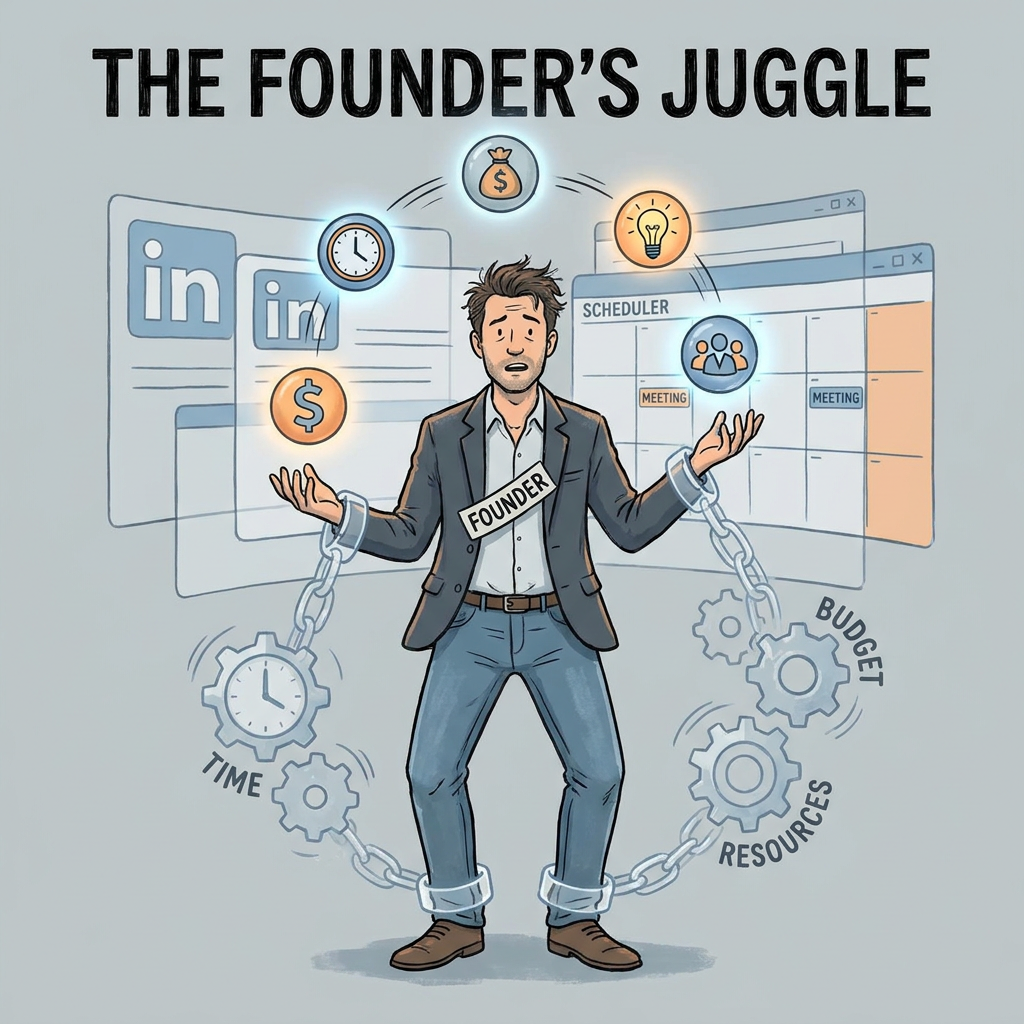
Founders rarely have uninterrupted afternoons dedicated to content. Meetings, hiring, sales and product decisions constantly interrupt creative work. Any content system that expects hours of weekly planning is unlikely to survive beyond the first few weeks.
Small interruptions also make context recovery expensive. Systems should therefore minimise decisions and shorten the path from inspiration to publication.
Consider a realistic Tuesday for an early stage founder. A customer call runs long. A candidate cancels an interview and needs rescheduling. An investor update is due by end of day. Somewhere in the gaps between these obligations, the founder remembers they had a strong idea for a LinkedIn post on the drive to the office. By the time they open a blank document that evening, the original insight has softened into a vague memory, and writing from scratch now feels like starting a second job at the end of an already long day.
This is not a discipline problem. It is a design problem. Expecting founders to behave like full time content creators, with dedicated blocks of quiet, uninterrupted writing time, ignores how founder schedules actually work. A system built for founders needs to assume interruption as the default condition, not the exception. That means capturing an idea in seconds, not minutes, and turning that captured idea into a workable draft without requiring the founder to reconstruct their original thinking from memory hours later.
The founders who publish consistently over the long run are rarely the ones with more free time. They are the ones whose systems require the least amount of protected, uninterrupted time to produce something worth publishing.
What Founders Actually Need
An effective platform should recommend relevant ideas, generate structured first drafts, organise approvals, maintain brand voice and only then present scheduling. Calendar functionality becomes valuable only after the difficult work has already been simplified.
Integrated workflows reduce dependency on spreadsheets, chat threads and multiple browser tabs while making collaboration easier for agencies and internal teams.
Idea recommendation matters more than most founders initially expect. Left entirely to their own instincts, most founders default to writing about the same two or three topics they feel most confident discussing, which leads to a feed that starts to feel repetitive even to their most loyal followers. A platform that can surface relevant angles, industry trends, and formats the founder has not tried yet keeps the content fresh without demanding hours of independent research.
Structured first drafts matter for a similar reason. A blank page is intimidating regardless of how much expertise someone has. A first draft built from a founder's own expertise and framed around a proven structure, whether that is a personal story, a contrarian opinion, or a lessons learned format, gives the founder something concrete to react to and refine rather than something to invent from nothing.
Approval organization matters most for founders who work with a marketing lead, an assistant, or an agency. Without a shared system, feedback tends to live in scattered messages: a comment in one thread, a voice note in another, a quick edit suggested verbally in a hallway conversation that never makes it back into the actual draft. Centralizing that feedback into one place, attached directly to the content it refers to, removes an entire category of miscommunication.
Brand voice preservation, finally, protects the founder from the awkward experience of publishing a post that technically covers a good topic but does not sound like them. Audiences on LinkedIn build trust with a specific voice over time. A tool that helps maintain that voice, even when someone else on the team is assisting with drafts, protects the credibility the founder has spent months or years building.
Beyond Output Speed
Speed alone is not the goal. Publishing more low quality posts rarely improves results. The objective is reducing repetitive work while preserving authenticity and strategic thinking.
The strongest tools support human judgement rather than replacing it. Smart drafting assistance should accelerate the mechanical parts of writing while leaving final messaging under the creator's control.
There is a temptation, once a founder discovers a tool that makes publishing easier, to simply publish more often without asking whether more is actually better. LinkedIn's feed is already saturated with generic advice, recycled frameworks, and posts that could have been written by anyone in any industry. Adding more volume to that noise does not help a founder stand out. It usually does the opposite, training an audience to scroll past content from that account because it no longer feels worth stopping for.
The founders who benefit most from a smarter drafting process are the ones who use the time they recover, not to publish more often, but to think more carefully about what they publish. A first draft generated in minutes instead of an hour does not need to go straight to the scheduler. It can go through one more round of editing, one more gut check on whether the opinion expressed is genuinely the founder's own, one more pass to strip out any phrase that sounds like it could have come from a template. That extra round is where authenticity survives efficiency instead of being sacrificed to it.
This distinction, between tools that simply produce more content and tools that produce better decisions about content, is the real dividing line worth paying attention to when evaluating any LinkedIn platform.
The Persona Lens: How Different Operators Use LinkedIn Tools
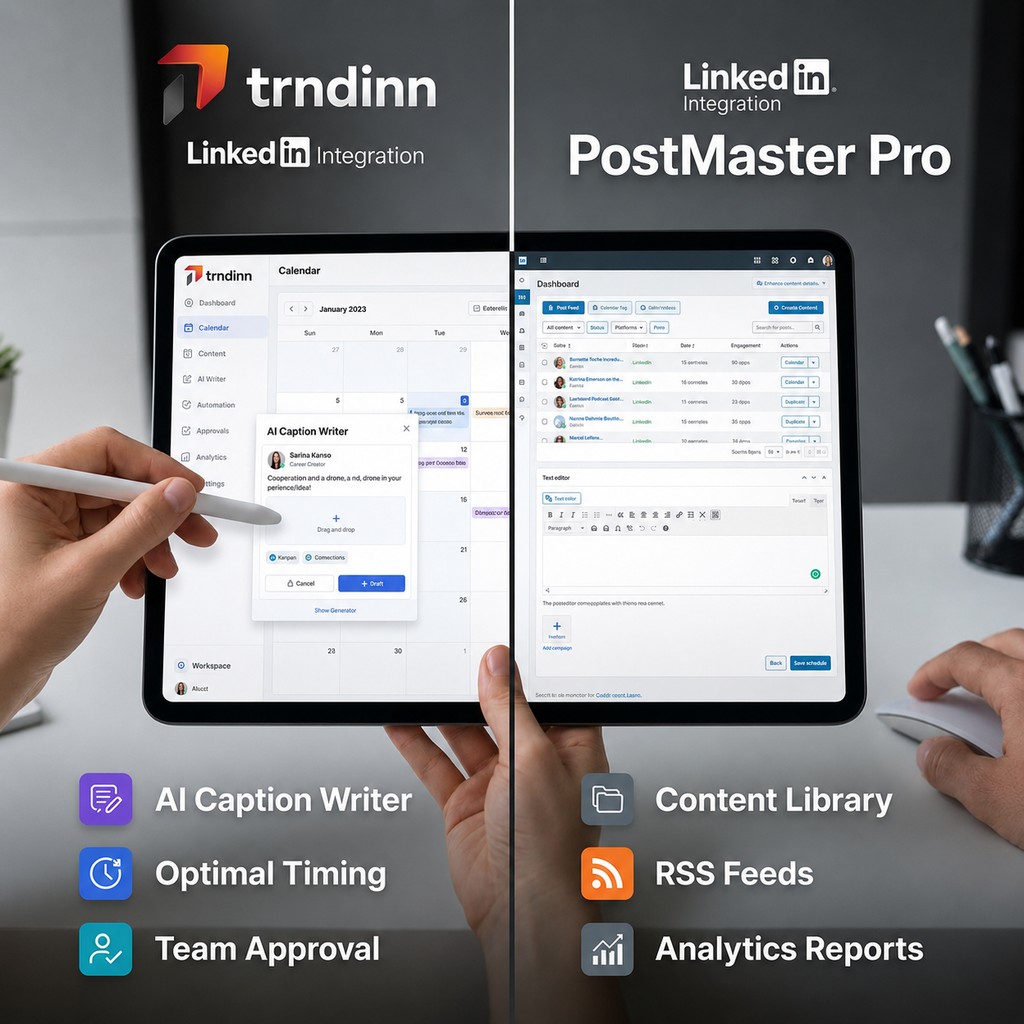
Founders are not the only people who need a system built around real constraints, though their constraints are often the most visible. It is worth looking at how a few other groups experience the same underlying problem differently.
Marketing leads inside growing companies are usually balancing founder content, company updates, and case studies at once, while being expected to show clear results to leadership. For this group, the value of a strong system is less about recovering personal time and more about proving that content investment is translating into pipeline. A tool that connects drafting, publishing, and performance data in one place makes that case far easier to build than stitching together a report from five disconnected sources.
Agency owners face constraints that multiply across every client they manage. What takes a founder a few minutes to review might take an agency an entire afternoon once repeated across ten client accounts, each with its own brand voice, approval chain, and reporting expectations. For agencies, a shared system is not a convenience. It is the difference between growing the client roster and hitting a capacity ceiling that forces them to turn away new business.
Freelance consultants and ghostwriters sit somewhere between these two groups. They are often managing several client voices at once, switching between platforms for writing, design, scheduling, and reporting throughout the day. For this persona, the biggest win from a connected system is simply reducing the number of places they have to remember to check, since every extra tool is one more place a client's feedback or a missed deadline can quietly slip through the cracks.
Independent LinkedIn creators, meanwhile, care most about consistency and idea variety, since their entire personal brand depends on showing up reliably with fresh perspectives rather than repeating the same three talking points every month.
Seeing these different needs side by side makes one thing clear. There is no single "best" feature that serves every persona equally. The best systems are the ones flexible enough to meet a founder's need for speed, an agency's need for scale, and a creator's need for variety, all inside the same underlying structure.
Evaluation Framework
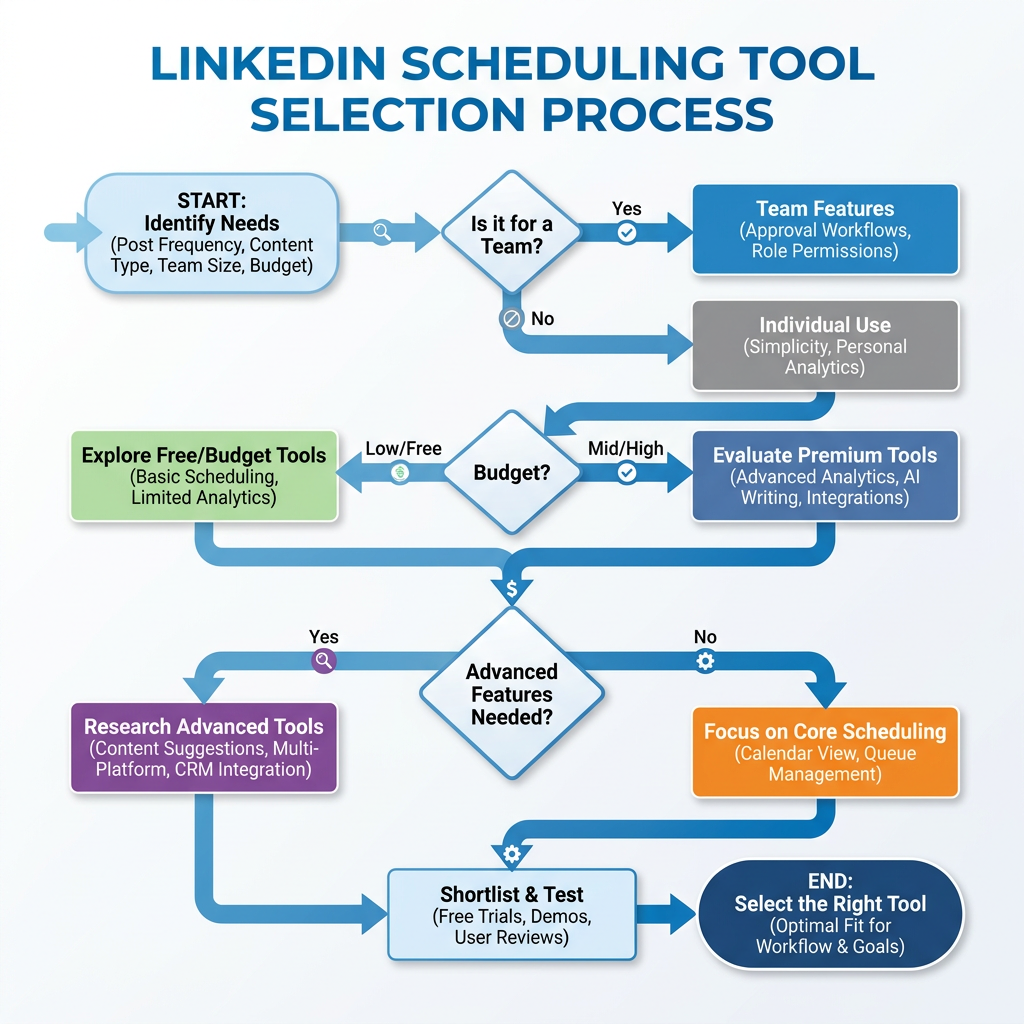
When comparing tools, measure time saved before scheduling, collaboration quality, workflow visibility, drafting usefulness, analytics integration and ease of reuse. These dimensions have greater long-term impact than the appearance of the calendar interface.
A useful question is whether the platform helps publish consistently for six months rather than whether it can queue fifty posts in advance.
Time saved before scheduling is the most overlooked metric in most buying decisions, simply because it is harder to demonstrate in a two minute product demo than a drag and drop calendar. Ask specifically how long it takes to go from a rough idea to a polished, on brand draft, because that gap is where most of the real cost of content creation actually lives.
Collaboration quality deserves close attention for any team larger than one person. Ask whether feedback lives in the same place as the draft it refers to, or whether it requires exporting, emailing, or switching tools to communicate. The answer to this question predicts how smoothly a team will scale its content output as headcount grows.
Workflow visibility matters for accountability. A founder or marketing lead should be able to see, at a glance, what is drafted, what is pending approval, and what is scheduled, without having to ask a team member for a status update. Tools that hide this information behind separate dashboards make simple status checks unnecessarily time consuming.
Analytics integration determines whether past performance actually informs future decisions. A tool that shows analytics in isolation from the drafting process is asking the team to manually connect insight to action, which in practice means that connection rarely gets made consistently.
Ease of reuse, finally, reflects how well a tool respects the reality that good ideas often deserve a second life. A strong post from three months ago might deserve a follow up, a related angle, or a repurposed version for a different platform. Tools that make it easy to find, reference, and build on past content save creators from reinventing ideas that already proved themselves.
What Six Months of Consistency Actually Looks Like
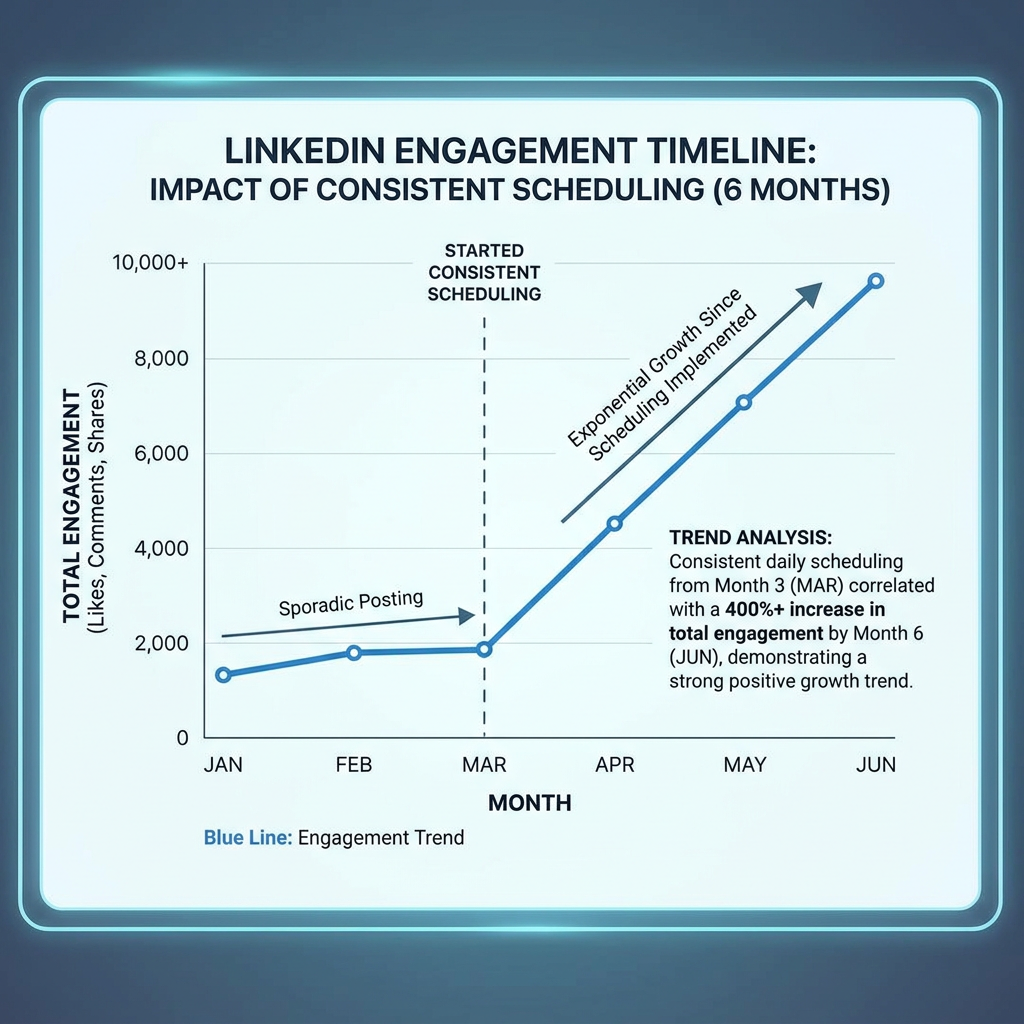
It is worth being concrete about what sustained publishing actually produces, because the benefits rarely show up in the first few weeks.
In the early stage, most of the value is invisible. A founder posting twice a week for the first month might see modest engagement, a handful of new connections, and little else that feels like measurable progress. This is normal, and it is also exactly the point where most people without a sustainable system give up, mistaking a slow start for a sign that the effort is not worth continuing.
By the third or fourth month, patterns start to emerge. Certain topics consistently perform better than others. Certain formats, whether personal stories, contrarian takes, or behind the scenes updates, generate noticeably more comments and shares. A founder who has kept a connected record of what worked can start doubling down on those patterns instead of guessing.
By month six, the compounding effect becomes visible in ways that are much harder to achieve through occasional bursts of content. Inbound messages start referencing specific posts. Prospective customers or hires mention having followed the founder's content for months before ever having a direct conversation. This is the version of LinkedIn growth that actually moves a business forward, and it is only accessible to founders whose systems survived long enough to reach it.
The Real Cost of Choosing the Wrong Tool
It is worth naming what happens when a founder picks a tool based on the scheduling screen alone, because the consequences show up slowly and are easy to misattribute.
The first few weeks usually feel fine. The calendar looks organized, posts go out on time, and everything appears to be working. The trouble starts a month or two later, once the founder realizes they are still spending the same amount of time drafting as before, just now paying for a subscription on top of it. The scheduler did its one job well. It simply never addressed the part of the process that was actually consuming the most time and energy.
At that point, many founders conclude that LinkedIn content itself is not worth the effort, when the more accurate conclusion is that they solved the wrong problem. The tool optimized the five minutes it takes to queue a post while leaving the ninety minutes it takes to write one completely untouched. Judging a founder's content strategy by whether the calendar looks tidy is a bit like judging a restaurant by how organized its reservation book is. It might reflect something, but it says nothing about whether the food is any good.
This is also where switching costs quietly accumulate. Every month spent with a tool that only solves scheduling is a month where drafts still live in a separate document, feedback still happens over chat, and brand voice still has to be reconstructed from memory for every new post. Founders who eventually move to a more connected system often describe the transition not as an upgrade but as a relief, because they had not realized how much of their own mental effort had been quietly absorbed by managing the gaps between disconnected tools.
Conclusion
The best LinkedIn scheduling tool is ultimately the one that reduces the entire publishing workload instead of optimising only its final step. That is the design principle behind Trndinn.
By removing friction throughout the process, founders can focus attention on building their companies instead of managing disconnected software.
A calendar was never going to be the thing that made a founder's LinkedIn presence succeed. The thinking, the drafting, and the consistency behind that calendar always were. Any evaluation of a LinkedIn tool that starts and ends with the scheduling screen is asking the wrong question from the very beginning.
What is the biggest bottleneck standing between you and a consistent LinkedIn presence right now? Share your experience in the comments below.
Quick Answers
- Why is scheduling not the most important feature of LinkedIn tools for founders?
- Scheduling is often overemphasized, but the real challenge lies in generating valuable content ideas and maintaining a consistent publishing cadence. These tasks are less visible but more crucial than just scheduling posts.
- What are the main challenges founders face when creating LinkedIn content?
- Founders often struggle with finding time to create content due to their busy schedules filled with meetings, hiring, and other responsibilities. They need a system that accommodates interruptions and makes idea capture and content creation seamless.
- Why do founders stop using LinkedIn scheduling tools after a few weeks?
- Many founders stop using scheduling tools because the tools don't address the real bottleneck: generating and developing content ideas. Scheduling is easy, but creating meaningful content is the hard part.
- How can LinkedIn content systems be better designed for founders?
- Systems should minimize decision-making and quickly turn captured ideas into drafts, accommodating the founder's busy and interrupted workflow instead of requiring long, uninterrupted blocks of time.
- What makes a founder consistently successful in publishing on LinkedIn?
- Successful founders use systems that require minimal uninterrupted time to produce quality content. These systems capture ideas quickly and help in developing them into publishable drafts efficiently.
Enjoyed this article?
Get more like this in your inbox.
No spam, unsubscribe anytime.
More from the blog
All posts
Why Is My LinkedIn Reach Dropping in 2026? (And How to Fix It)
If your LinkedIn posts are pulling a fraction of the views they used to, you are not imagining it and you are not alone. Reach has dropped across the platform in 2026, driven by a shift from a Relationship Graph to an Interest Graph and a unified ranking model called 360Brew. This guide breaks down what changed, five real reasons your specific reach may be down, how to diagnose which one applies to you, and what to fix first.
10 min read

How to Run a LinkedIn Marketing Agency in 2026
Running a LinkedIn agency in 2026 isn't harder because LinkedIn changed. It's harder because the agencies competing with you got faster. This playbook covers positioning, pricing, onboarding, a repeatable content system, and the kind of reporting that actually earns a renewal, plus why most agency churn is an operations problem wearing a strategy costume.
10 min read

Social Media for Busy Founders: A Simple System From Idea to Scheduled Post
Most founders know they should be posting. Almost none of them have the spare hours to do it the way most advice assumes. This guide covers why social media is usually the first thing busy founders drop, what it actually costs them to stay quiet, and a system, from idea capture to Brand Voice drafting to scheduling, built for people who have almost no time to spend on it.
10 min read